Furnace Repair in Layton, UT
Most furnace problems announce themselves before they become a no-heat night: a bang at startup, a blower that squeals, heat that's strong in one room and weak in another, a system that starts, runs three minutes, and quits. These are repair problems, and they're diagnosable — a furnace is a chain of components that work in sequence, and when one link fails, the symptom usually points right at it. Your provider's job is to find the failed link rather than replace parts on a guess.
A repair visit starts with the diagnosis: ignition, blower, controls, and safety switches checked in order, with the findings explained to you in plain language. Then you get the repair laid out in writing before any work starts — what failed, what the fix involves, and what the system should do afterward. If the diagnosis turns up something bigger — a safety finding, an end-of-life unit — your provider tells you that straight, too.
One honest note: no reputable provider diagnoses a furnace from a description alone, and no one should quote a repair without standing in front of the unit. Symptoms narrow it down; the inspection settles it. That's why the first step is always a call and a look, in that order.
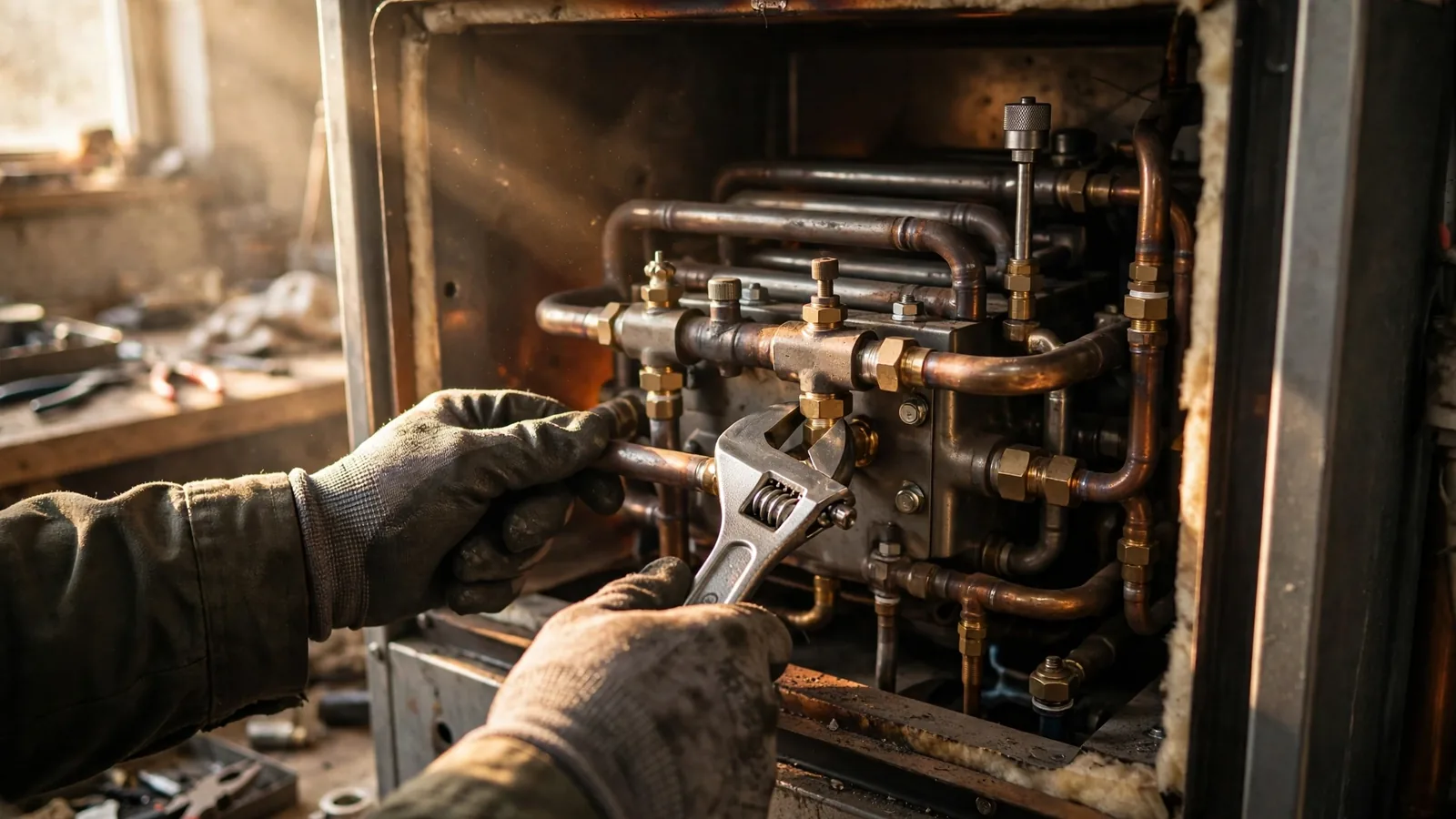
Signs your furnace needs a repair
- Banging, squealing, rattling, or grinding noises that weren't there last winter
- Short-cycling — the furnace starts, runs a few minutes, and shuts off, over and over
- Weak heat, or rooms that stay cold while others get warm
- A burner flame that's yellow and lazy instead of blue and steady
- The furnace breaker trips, or the system needs frequent resets to keep running
- A burning or electrical smell that doesn't clear after the first runs of the season
How your provider handles a furnace repair
1. Diagnosis at the unit
Your provider works through the sequence — thermostat call, ignition, blower, gas flow, safety controls — testing each link until the failure shows itself. The goal is the actual cause, not the first part that looks old.
2. Findings in plain language
You hear what failed, why it failed, and what the repair involves — in writing, before work begins. If more than one thing is going on, you hear about all of it, and which items are now and which can wait.
3. The repair itself
The failed component is repaired or replaced, connections and settings are verified, and anything the failure stressed — a limit switch, a sensor — gets checked rather than assumed fine.
4. Full-cycle testing
Your provider runs the furnace through complete heating cycles: normal startup, steady heat at the registers, clean shutdown. Safety controls and carbon monoxide readings around the unit get verified before the job is called done.
Furnace repair in Layton homes
Layton's repair calls follow the local housing script. In the 1970s–90s neighborhoods, original and second-generation furnaces are aging into the years where igniters crack, blower motors wear, and control boards fail — often in the same few seasons. In the newer subdivisions toward the bench, builder-grade units installed in the 2000s and 2010s are reaching that same window now. Basements house nearly all of them, which is good for access, and the long inversion run-hours along the valley floor mean a Layton furnace logs more cycles per winter than the same unit would in a milder climate. Local pros see these exact units and these exact failures on repeat, all winter long.
Need furnace repair in Layton?
One call connects you with a local technician. No forms.
(555) 234-5678📞 Call Now